
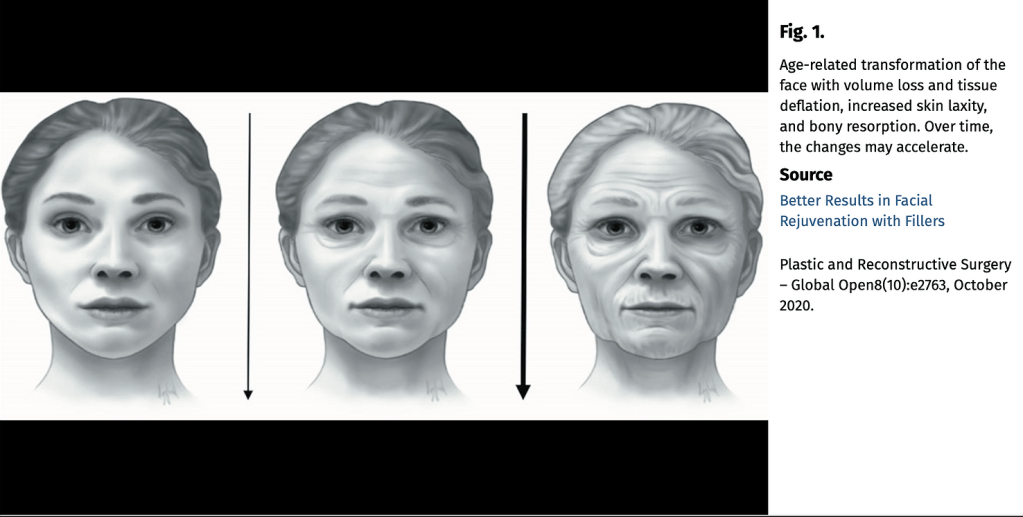
Facial aging is often associated with volume loss. In youth, a well-defined bony structure and supportive fat pads provide balanced fullness throughout the face. As we age, bone resorption and the deflation of fat pads occur. Additionally, tissues lose their support, becoming lax and descending, which contributes to a sagging appearance.
Fillers aim to restore lost volume caused by bone resorption and fat pad depletion. The most commonly used fillers are made of hyaluronic acid, a naturally occurring substance in human skin. Depending on their manufacturing process, fillers vary in consistency and firmness, which determines their suitability for treating specific facial areas and addressing various aesthetic concerns.
More robust fillers are typically injected deep into the cheeks, where they serve as lifting vectors for the lower face, indirectly softening the nasolabial folds and jowls. Their firmer consistency also makes them ideal for enhancing the jawline, chin, and nose by mimicking bone structure and altering the face’s contours. Thinner fillers, on the other hand, are better suited for superficial placement in delicate areas like the tear troughs. They can also soften wrinkles and minor imperfections while hydrating and improving skin quality.
Reference:
Akinbiyi, Takintope MD; Othman, Sammy BA; Familusi, Olatomide MD; Calvert, Catherine MD; Card, Elizabeth B. BS; Percec, Ivona MD, PhD Better Results in Facial Rejuvenation with Fillers, Plastic and Reconstructive Surgery – Global Open: October 2020 – Volume 8 – Issue 10 – p e2763 doi: 10.1097/GOX.0000000000002763
 Dr Maria Gkreka